
How the Estate-Liquidity Process Works
Understand the need, involve the right people, and decide whether insurance belongs in the plan.
The starting point is a question about cash, not an application. Marc contributes an insurance-focused perspective while your existing advisors address the legal, tax and investment work within their roles.
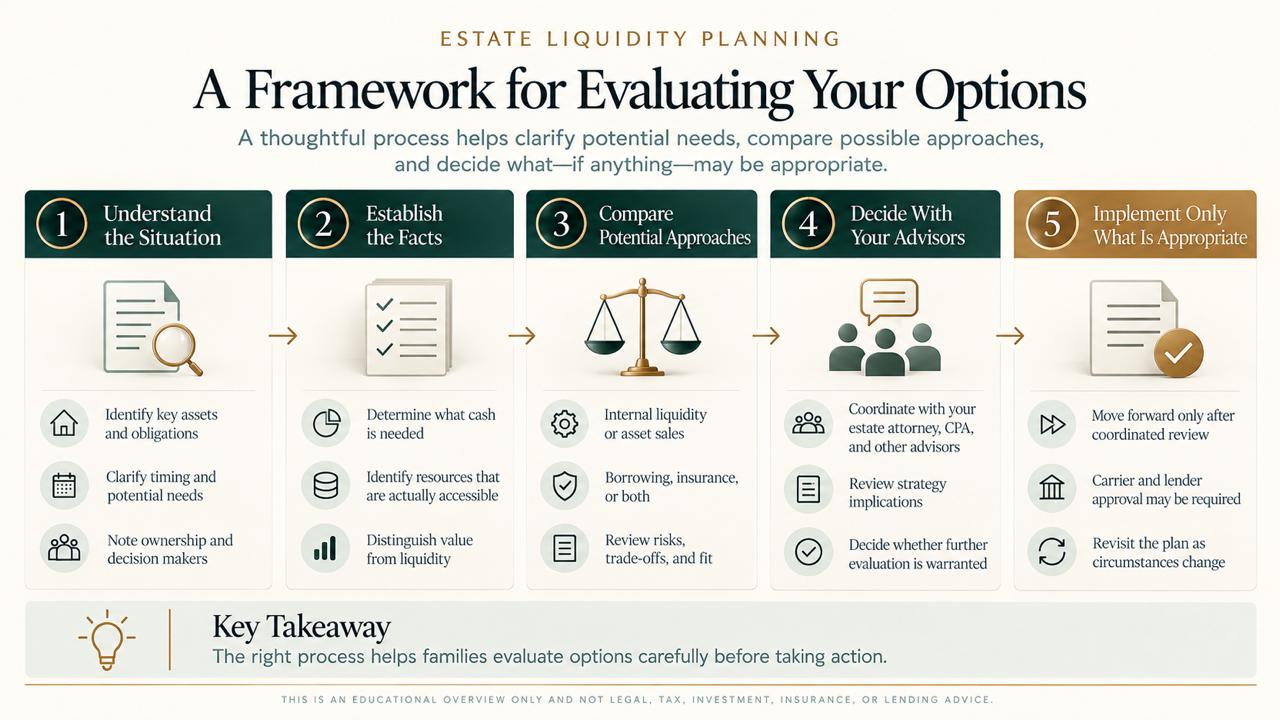
1. Describe what needs attention
Start with the concern: a business transition, wealth held in property, an estate expense, or uncertainty about existing coverage. Discuss the broad situation and any known timing issue.
The first conversation helps establish whether there is an insurance-related question worth pursuing. It does not produce a tax calculation or determine that a transaction is needed.
2. Establish the facts and the right scope
Before an insurance decision, the relevant professionals need to establish the assumptions it would depend on. Those may include the obligation, its timing, who owns the available assets and who has authority to use them.
Marc can help identify questions for the insurance discussion. Your legal and tax professionals determine the legal and tax position. If information is missing, the next step may be to resolve that issue rather than develop a proposal.
Any further work and information sharing should have an agreed purpose and scope.
3. Compare the available approaches
Existing cash, investments, sales and credit may already provide workable options. Your advisors should consider those before a new insurance commitment is made.
If insurance merits evaluation, the discussion turns to the coverage need, existing policies, ownership, premiums and the resources required to keep coverage in place. Financing the premiums is a separate decision, not an automatic part of buying insurance.
The comparison should make room for a simpler approach or no new transaction.
4. Decide whether to proceed
An illustration shows assumptions; it is not an approval or a guarantee of every future value. The carrier determines whether it will offer coverage and on what terms. If borrowing is considered, the lender separately evaluates the loan.
Before choosing, understand the costs, contractual obligations and what would happen under less favorable conditions. You should also know which professional is responsible for each part of the proposed arrangement.
5. Implement only what has been agreed
If you decide to proceed, the appropriate parties handle their own applications, documents and approvals. Marc’s involvement concerns the insurance transaction within his authorized role. Attorneys address legal documentation; lenders control their credit decisions and loan terms.
Neither a consultation nor a favorable preliminary discussion means that coverage or financing has been approved.

Who is responsible for what?
Participant | Responsibility to clarify |
You and any authorized decision-maker | Goals, information, consent and the decision to proceed. |
Marc / SPF | Insurance-focused discussion and any agreed insurance work within the authorized scope. |
Estate attorney | Legal structure, ownership, document terms and authority. |
CPA / tax professional | Tax assumptions, calculations, reporting and advice. |
Wealth advisor or family-office team | Investment and liquidity decisions within their mandate. |
Insurance carrier | Underwriting, policy terms and administration. |
Lender, if applicable | Credit approval, collateral requirements and loan terms. |
An executor or trustee may have duties distinct from those of family members. Actual authority comes from the governing arrangements, not this table.

Agree on review responsibilities before implementation
A policy and a loan can change in different ways. Any financing arrangement needs attention to its terms, costs, collateral and repayment assumptions.
Before proceeding, establish who will obtain current information, who will review it and which changes require a prompt decision. Do not assume that one professional is monitoring every part of the arrangement.
This page does not promise an SPF annual monitoring service. Any ongoing work requires an agreed scope.

Take the first step without committing to the last
You can ask an estate-liquidity question before deciding whether insurance makes sense. See what the initial consultation covers.
SPF does not provide legal, tax, accounting or investment advice. Marc’s compensation is tied to implemented insurance transactions, not a separate planning or advisory fee. Understand compensation and conflicts.