
Your business has value. Who can use it, and when?
A succession plan can identify the next owner without settling where the purchase money, estate cash or family support will come from.
Your company may be worth a great deal. That value may sit in customer relationships, equipment, inventory and future earnings rather than cash someone can draw today.
If an ownership transition raises a funding question, Marc Setton brings an insurance-focused estate-liquidity perspective alongside your existing advisors. Neither a new policy nor a loan is assumed.
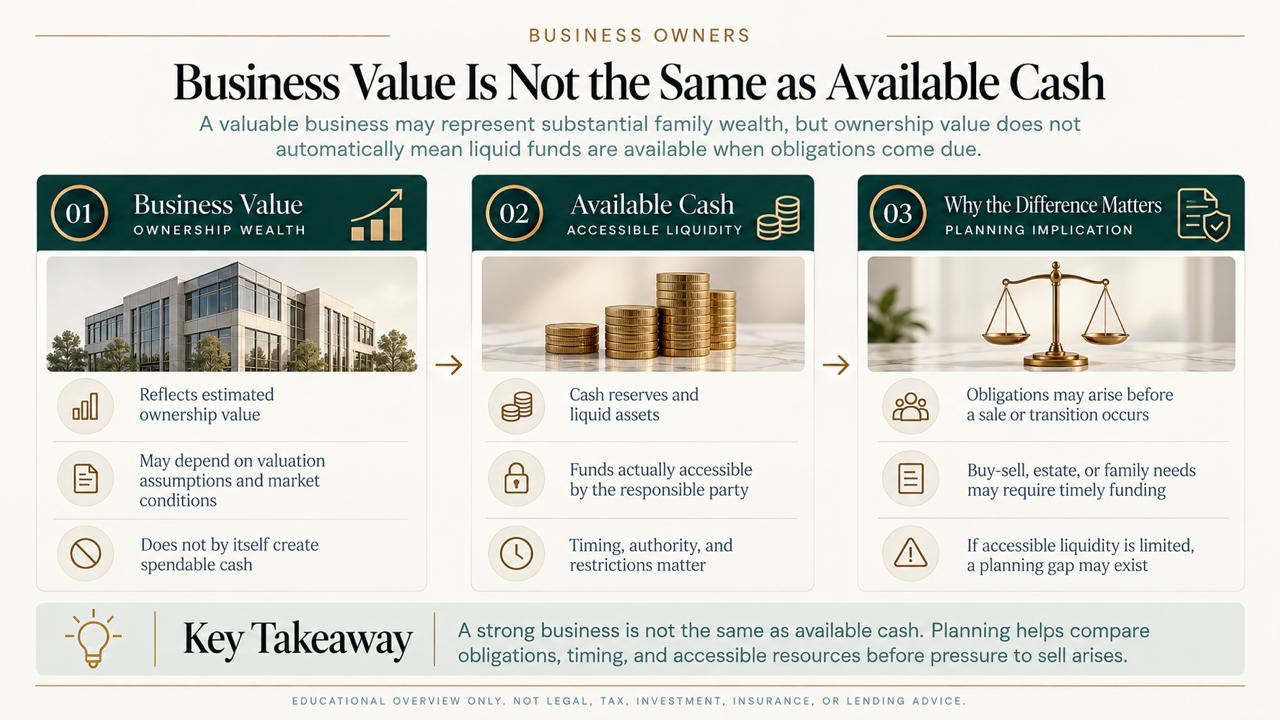
A valuation is not a funding source
Estate liquidity concerns the funds available to meet an estate’s obligations when they arise. For an owner, that question connects with the company but is not the same as running it.
The estate may need cash while the company needs working capital. A surviving partner may need to purchase shares while the family needs income. Identify each need separately: the company, buyer and estate are not interchangeable.
A privately held interest may lack a ready buyer or have transfer restrictions. Even cash inside the company may be committed to payroll, inventory or debt. Ownership of valuable shares does not by itself establish access to those funds.
Concentration alone does not prove a shortfall. Existing resources may be enough. The point is to check their availability against the actual obligation.

Five situations worth bringing to your advisors
The transfer plan is clearer than its funding
The intended buyer or next generation is identified, but the source and timing of payment remain uncertain.
The agreement and the resources no longer match
Ownership, an agreed price or insurance funding has changed since the buy-sell arrangement was reviewed.
Family members want different things
One wants to operate the company; another may prefer assets outside it. The funding question follows the family's goals, not an assumed rule of equal ownership.
Business and family cash needs could compete
Working capital, debt, guarantees or continuity costs may limit the money available elsewhere. Their legal effect needs review, not assumption.
An estate obligation depends on a future sale or distribution
Ask what happens if the buyer, payment or available company cash arrives later than expected.
These are reasons to ask a question, not evidence that estate tax applies or insurance is needed.

A signed buy-sell agreement is not the same as a funded agreement
Start with who would buy, how the price would be established and when payment would be due. Then examine the intended funding and what happens if it falls short.
An agreement may address several kinds of departure. A life insurance death benefit does not fund a retirement or disability event merely because the same agreement covers it.
Keep the purposes of coverage distinct. Insurance intended to support the company after losing a key person is not automatically money available for an ownership purchase or the family’s needs. The policy, beneficiary and agreement need to align; counsel determines the legal arrangement.
Company-owned insurance can also raise valuation and tax questions. Have the attorney, tax professional and valuation specialist consider those alongside the insurance terms. Marc does not determine business value or design the agreement.

Six questions before choosing a funding approach
- Where is the wealth? Separate personal assets, business interests and company cash.
- When might cash be needed? Distinguish an immediate obligation from payments that may occur over time.
- Who needs access? Name the person or entity that must pay, and the one expected to receive money.
- How could the resource become cash? Identify any buyer, approval or distribution the plan depends on.
- What if the timing is unfavorable? Consider a delayed sale or lower distributions without assuming either will happen.
- What else could fund the need? Compare available reserves, investments, a planned sale, borrowing and existing coverage before adding a new commitment.
A planned sale can be the right choice. So can keeping the company. Funding should support the intended ownership outcome rather than decide it by default.
Understand the broader funding approaches. If property holdings create a separate concern, explore the real-estate liquidity questions.

Where an insurance discussion may help
Existing coverage may already address part of an identified need. If new life insurance is considered, its purpose, cost, underwriting and access to proceeds need evaluation with the relevant advisors. Insurance does not replace a management succession plan.
Only then consider how premiums would be paid. Premium financing uses a separate loan to fund insurance premiums. It adds interest, repayment obligations and possible collateral demands; policy performance and lender renewal cannot be assumed. Direct payment or no new policy may be more appropriate.
Learn how premium financing works if borrowing for premiums is actually under consideration.

Keep the professional roles clear
Your estate attorney addresses legal structure and documents. Your CPA or tax professional handles tax and accounting analysis. The wealth advisor considers the wider financial picture; business and valuation professionals contribute within their engagements.
Marc Setton, Estate Liquidity Strategist, contributes insurance-related questions and any agreed insurance implementation within his authorized role. He does not replace those professionals or take responsibility for the entire succession plan. Agree who will coordinate the work and who owns each decision.
Marc does not charge a separate planning or advisory fee for this work. He is compensated when an insurance transaction is implemented, under the applicable insurance compensation arrangement. Read about compensation and conflicts.
Start with the unresolved cash question
You do not need a finished proposal. Describe the transition or funding concern in general terms. Do not send financial statements, agreements or confidential family information through the initial inquiry form.